what does it mean to say correlation doesnt imply causation

You might call up this simple mantra from your statistics grade:
"Correlation does not imply causation."
So maybe you think you know what this phrase means.
Like, if you studied actually hard in statistics, got a skillful grade, and and so got into higher, it must hateful that you got into college because you aced Statistics form.
While that class, along with the skills you learned, probably helped, you can't ignore the other factors at play - and likely tin can't argue that your Stats grade was the cause of your credence into college.
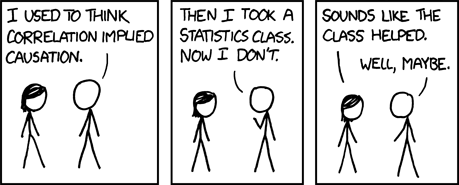
Get-go things showtime - why exercise we mistake correlation with causation?
Information technology's easy to think that only because two things seem related, that 1 must be the cause of the other. Just that tin can exist a foolish and sometimes dangerous supposition.
For example, suppose yous're trying to figure out what makes people less grumpy. Yous perform a study which finds that, when people become at least x hours of slumber a night, they're less grumpy.
But take you taken all factors into account here? Perchance they also started working out more as a effect of being well-rested, and this is what altered their moods.
Not all examples are quite so benign - and some are downright nonsensical.
To illustrate how misleading it tin exist to presume that correlation implies causation, take a wait at the following graph from Tyler Vigen's Spurious Correlations:
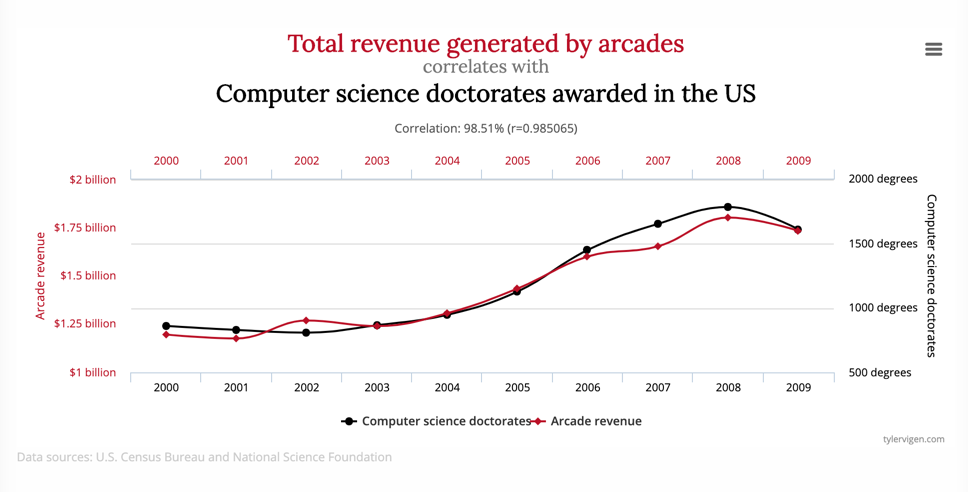
While in that location happens to be a strong correlation between these two factors, I doubt yous could effectively fence that one acquired the other. Perhaps this volition be a challenge for people to try and prove.
Hither's another gem from Tyler's collection:
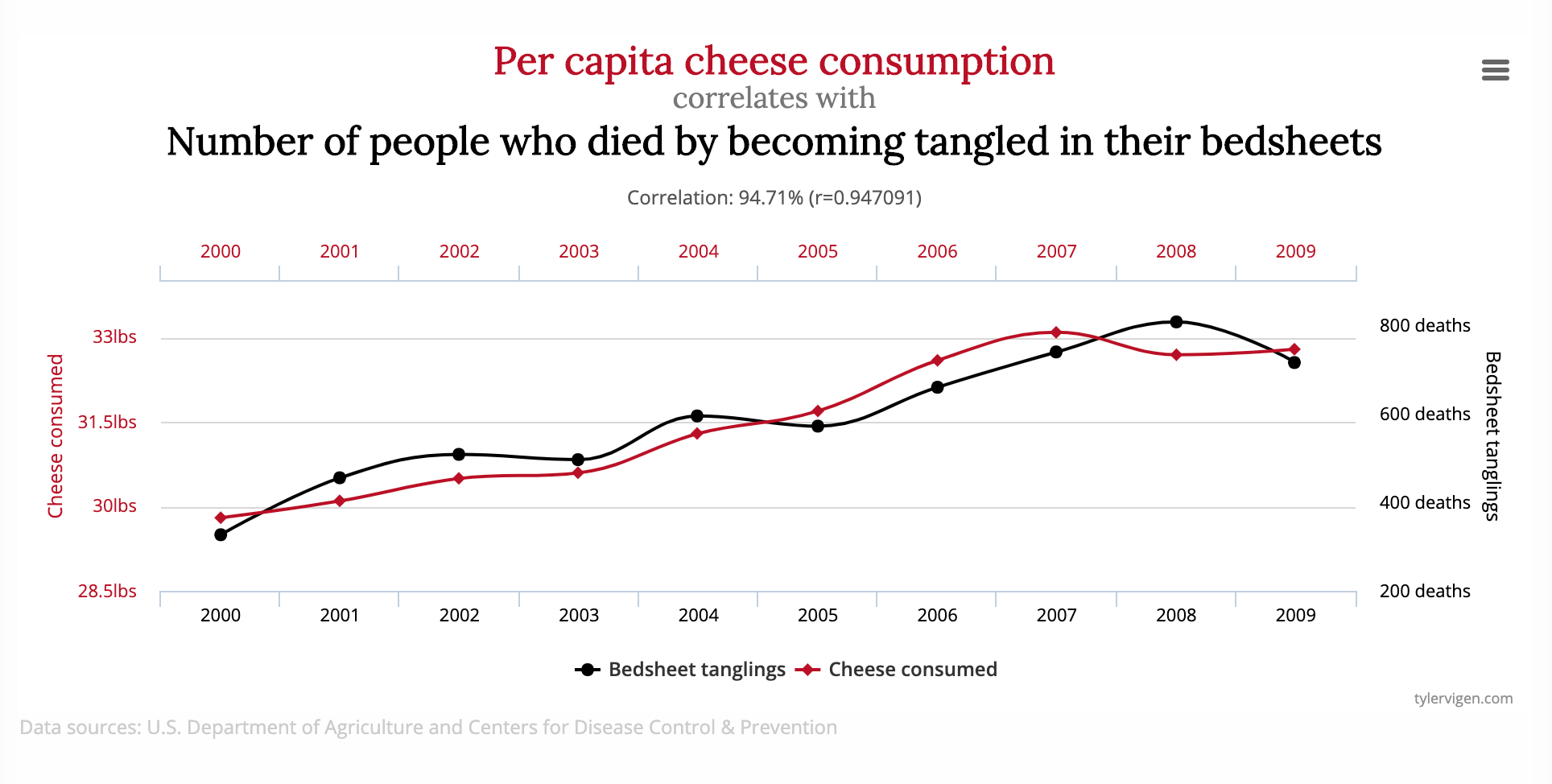
Expect at that cute correlation. But you'd be difficult pressed to argue that, but considering someone ate more than cheese, they'd exist more likely to fatally entangle themselves in their bed sheets.
What is correlation in statistics?
According to the dictionary, a correlation is a common human relationship or connection between two or more than things (or variables) - especially ane that is not expected on the footing of risk alone.
Let's employ it in a sentence: The huge size of my homegrown tomatoes seems to correlate with the extra rain we had this summer.
At present, here I'm assuming that, considering it rained a bit more than usual, my tomato plants went nuts and produced monster tomatoes.
But is that the just factor? What well-nigh the nutrient rich compost I used in my raised beds? What nigh the quality of the plants I bought from the plant nursery? What nigh my careful pruning and tending?
Every bit you lot can see, although there is correlation between my large tomatoes and our rainy summer, this doesn't necessarily imply causation.
What is causation in statistics?
Fourth dimension for some other definition. Causation, according to the dictionary, is the deed or agency which produces an effect.
Let's get a fleck more specific. Causation means that at that place is a relationship between two events where one event affects the other. In statistics, when the value of an issue - or variable - goes up or downward because of another event or variable, nosotros can say there was causation. A acquired B to happen.
How nigh an case for this one? Maybe you freelance for a magazine that pays by the give-and-take. The longer the story (and the more words it contains), the more y'all get paid.
And so in that location'due south a direct correlation between how many words you write and how much y'all get paid. But at that place's also causation (because you wrote more, you got paid more).
Why is information technology and then easy to get this wrong?
Why is information technology and so easy to think that correlation implies causation? Well, if 2 things seem related, we tend to acquaintance them and assume they impact each other. When the weather's cold, people spend more time within. Around the holidays, shopping malls are packed. When y'all take some ibuprofen, your headache goes away.
While these circumstances certainly are related - and some might even imply causality - they don't necessarily stand up to scientific assay.
There are a few reasons we might mistakenly infer causation from correlation.
What is a Confounding Variable?
First of all, yous might have a confounding variable in the mix. This is a variable that affects both the independent and dependent variables in your relationship - and and so confounds your power to determine the nature of that relationship.
For instance, if a new family moves into a neighborhood, and crime goes up, the residents in that area might assume it's because of that new family. But what if, at the same time, a detention center opened nearby? That's the more likely cause of the increased crime.
What is Opposite Causation?
Second, you might exist dealing with reverse causation. This happens when, instead of correctly assuming that A causes B, you get them mixed upwards and assume that B causes A.
It might be difficult to imagine how this happens, but think of how solar panels work. They produce more power when the sun is in the heaven longer.
But the sun isn't in the sky longer because the panels are producing more power. The panels are producing more than ability considering the sun shines for longer periods of fourth dimension.
What is a Coincidence?
Third, we must non forget the ability of coincidence. When 2 things happen to occur at the same time, it's tempting to see causation. Only merely like that airheaded graph above, with the arcades and CS degrees, many are just coincidences.
In the terminate - why exercise we intendance?
Maybe you're trying to figure out whether a certain new drug makes patients feel better. Or y'all'd similar to know what makes people buy a certain production.
Whatever your motivation, it'south oftentimes very useful to figure out whether A causes B, along with how and why.
Merely as nosotros've seen, information technology's non that easy. You've got to control equally many factors as you can, reduce the likelihood of confounding variables and coincidences, and peel downwardly the data to what'due south relevant.
We won't go into the deeper philosophical question of how we can really plant causation without a dubiety. That'south for another time.
At least now you know that - fifty-fifty though two events or variables may seem related - it doesn't mean that one has a direct causal affect on the other.
Learn to code for free. freeCodeCamp'due south open source curriculum has helped more than than 40,000 people get jobs as developers. Get started
Source: https://www.freecodecamp.org/news/why-correlation-does-not-imply-causation-the-meaning-of-this-common-saying-in-statistics/
Belum ada Komentar untuk "what does it mean to say correlation doesnt imply causation"
Posting Komentar